




Commencement is not neutral ground at an HBCU. It is a civic altar — a place where the living inherit the unfinished work of the dead.
Commencement is not neutral ground at an HBCU. It is a civic altar — a place where the living inherit the unfinished work of the dead.
By KOLUMN Magazine
At South Carolina State University, commencement was supposed to be a clean ritual: gowns, processions, family photographs, a last walk across a stage that carries the weight of sacrifice. Instead, in the final days before the Spring 2026 ceremony, the stage became a test of institutional memory.
The controversy began when students learned that South Carolina Lt. Gov. Pamela Evette, a Republican candidate for governor and self-described “America First” conservative, had been invited to address graduates. Evette’s own campaign site says she has “proudly stood with President Trump” and “champion[ed] his America First agenda,” language that placed her squarely inside the same political current that has made diversity, equity and inclusion a prime target of federal and state power.
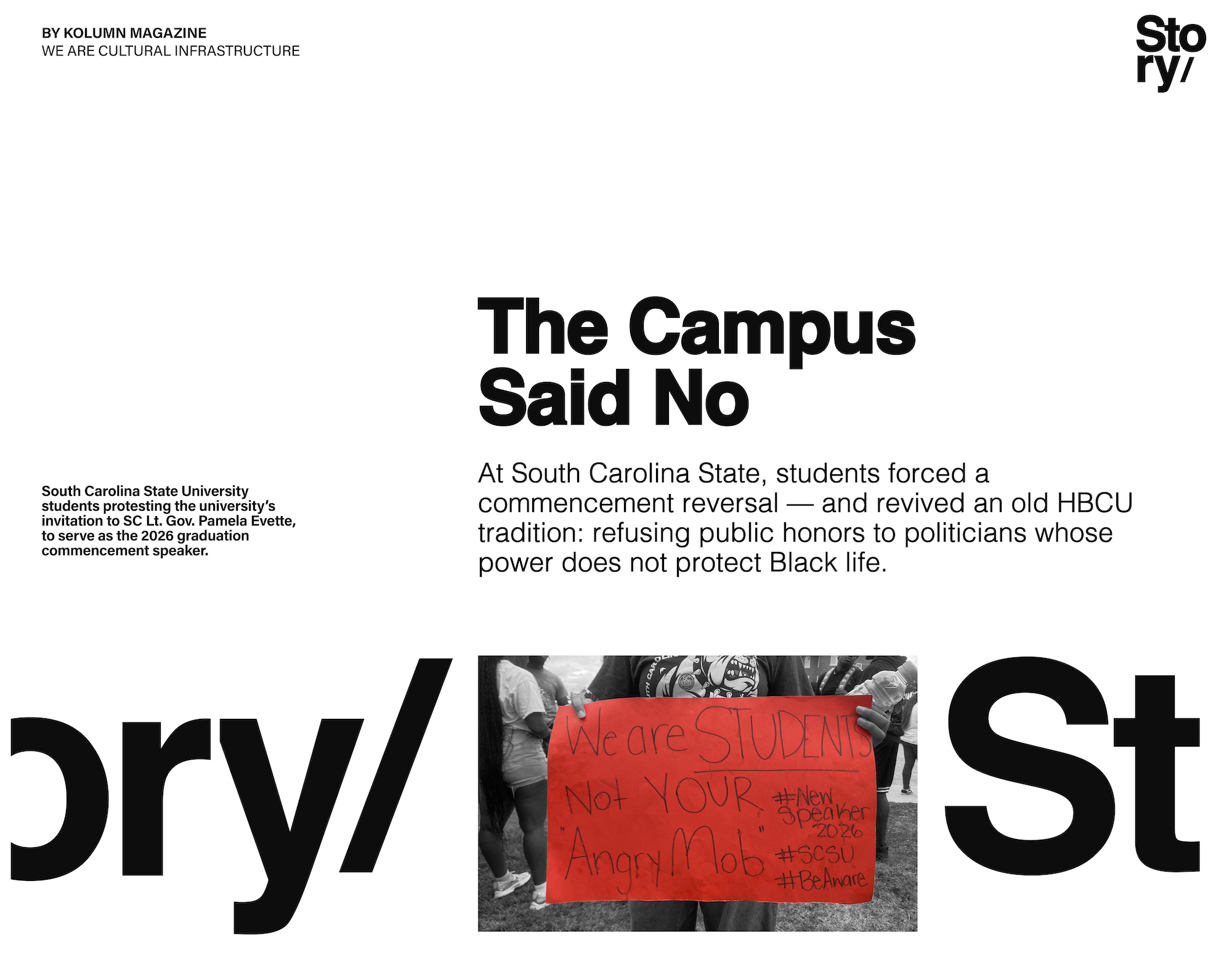
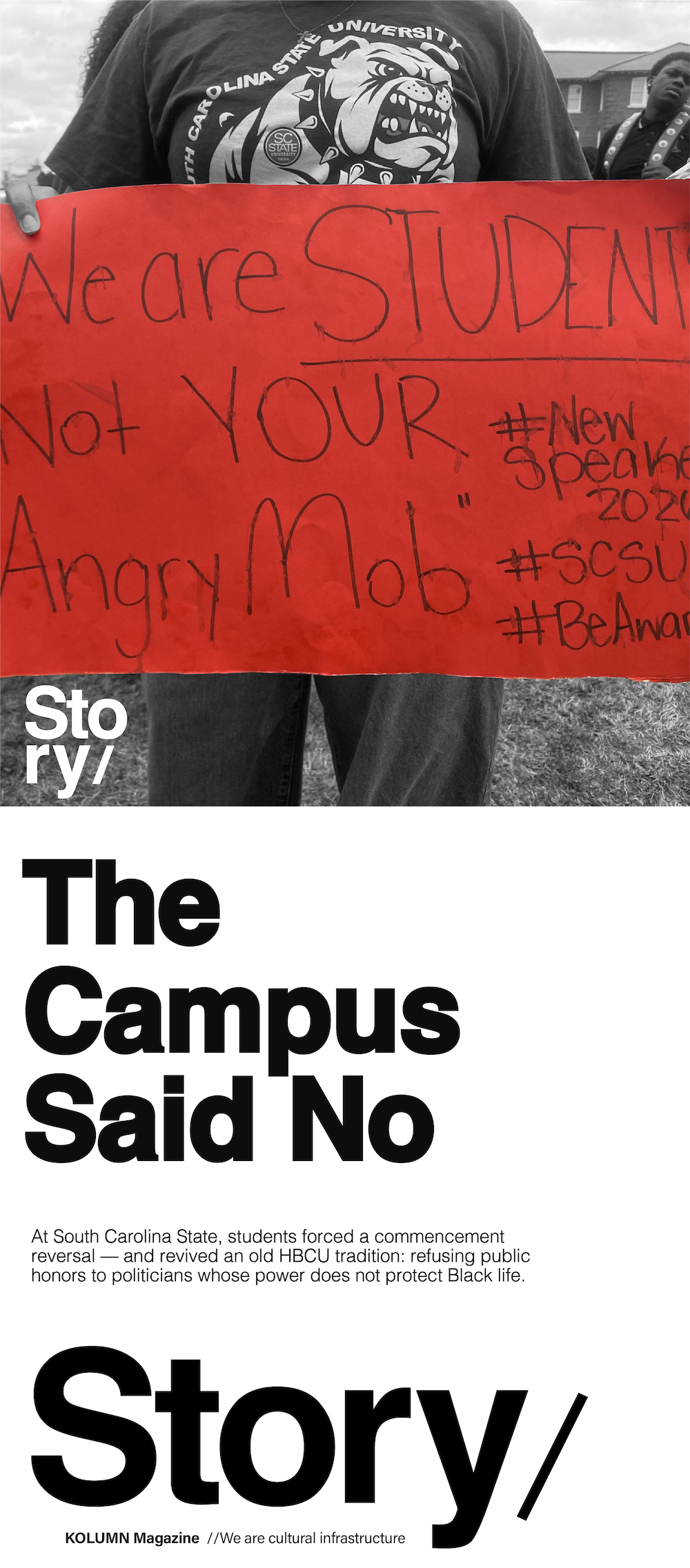
Students objected. They protested on campus. They said the decision did not reflect them. Some said they learned of the invitation through social media rather than through the university. They pointed to Evette’s opposition to DEI and questioned why a historically Black public university would hand its most celebratory platform to an elected official aligned with policies many students see as hostile to the conditions that made HBCUs necessary in the first place.

By Wednesday, April 29, 2026, SC State President Alexander Conyers announced that the university would “move in a different direction” for commencement, saying the decision came “out of an abundance of caution for safety and with careful consideration.” He also said Evette could be invited back later for a separate exchange with students, faculty and staff outside the ceremonial frame of graduation.
Evette’s response sharpened the meaning of the protest. According to WIS, she said, “I am against DEI. And I am a big supporter of the president,” while criticizing students with signs, bullhorns and chants as part of what she described as a broader campus pattern. She also reiterated her proposal to end tenure for college professors, saying universities needed to get rid of “indoctrination.”
That exchange — students rejecting a speaker, a politician denouncing DEI, a university trying to preserve order — was not merely a South Carolina controversy. It was a national argument compressed into one HBCU campus: Who gets honored in Black institutional space? What does “dialogue” mean when power is uneven? And why should Black students be expected to celebrate figures whose politics treat racial equity as a threat?
A Commencement Invitation Becomes a Political Flashpoint
SC State initially defended the invitation as a recognition of Evette’s business career. Conyers said the university had looked to her background as “a business leader and entrepreneur,” noting that she founded and led a company that grew from a startup into a national enterprise.
That explanation did not satisfy students. The objection was not that Evette had no résumé. It was that her public record carried a political meaning larger than biography. Her gubernatorial campaign branding reads “Conservative. Businesswoman. America First.” Her site praises President Trump’s return to power and frames her as a leader prepared to carry Trump-style conservatism into South Carolina’s next political chapter.
That alignment mattered because Trump’s second administration has made anti-DEI policy central to its education agenda. On Jan. 20, 2025, the White House issued an executive order titled “Ending Radical And Wasteful Government DEI Programs And Preferencing,” directing federal officials to terminate DEI and DEIA “mandates, policies, programs, preferences, and activities” across the federal government.
The Department of Education’s Feb. 14, 2025 Dear Colleague letter went further into the educational sphere, declaring that many schools and universities had used race in admissions, hiring, financial aid, training and “other institutional programming,” and warning that institutions could face loss of federal funding if they failed to comply with the department’s interpretation of civil-rights law. (U.S. Department of Education)
For Black students at an HBCU, that language does not land abstractly. DEI is not merely a campus office. It is a proxy battlefield over whether the history of exclusion can be named, whether institutions created because of racial exclusion can still explain their purpose, and whether equity work is treated as repair or as wrongdoing.
Evette did not distance herself from that project. She embraced the frame. She told reporters she was against DEI, supported Trump, and believed the protests showed why campuses needed to fight indoctrination.
The students, in turn, rejected the idea that their protest was ignorance. “We’re not a mob,” SC State junior Mayah Asbury told WACH. “We’re just aware of what we stand for as a historically Black community college and university.” Another junior, Kaitlyn Pinckney, said Evette was “going against what the same exact students are here for.”
The HBCU Stage Is Not Just a Podium
The fight at SC State echoes a recurring theme in KOLUMN’s coverage of Black institutional history: Black spaces are never only buildings. They are memory systems. Whether in stories about the First Freedom Ride, Ida B. Wells confronting segregation on a train, or the long architecture of Black civic resistance, the question is often the same: when official power asks Black people to be polite in the face of policies that harm them, who refuses?
At SC State, that refusal carried local gravity. The university is South Carolina’s only public HBCU and traces its founding to 1896, when Black higher education in the state was still shaped by Reconstruction’s promises and Jim Crow’s betrayals.
Its campus also holds one of the most searing student-protest histories in America. On Feb. 8, 1968, Henry Smith, Samuel Hammond and Delano Middleton were killed when police opened fire on roughly 200 unarmed Black students protesting segregation at a local bowling alley; 28 others were wounded. SC State commemorates the Orangeburg Massacre annually, and its convocation center is named for Smith, Hammond and Middleton.
That history makes student protest at SC State something more than episodic unrest. It is institutional inheritance. When students gather, chant, object and demand accountability, they are not stepping outside the university’s story. They are stepping into it.
“To call HBCU student protest a disruption is to forget that disruption helped build the democratic space Black students now occupy.”
The broader history of HBCU activism supports that reading. The Smithsonian’s National Museum of African American History and Culture describes Black colleges as epicenters of dissent in the postwar era, noting that HBCU students and alumni helped challenge Jim Crow and fuel the civil-rights movement. The Atlantic has similarly noted that the 1960s movement was powered by youth leaders and student activists, including the North Carolina A&T students whose 1960 Greensboro sit-in helped ignite a wave of direct action across the South.
In that historiography, Black colleges are not passive recipients of democracy. They are laboratories of it. Scholars such as Jelani Favors have argued that HBCUs functioned as “shelters” and training grounds for Black leadership, cultivating students who learned to connect education with liberation.
SC State’s students were operating in that lineage. Their demand was not that Evette be silenced everywhere. It was that commencement — their commencement — not be used to symbolically validate politics they believe undermine Black educational life.
DEI, Trumpism and the Politics of “Merit”
Evette’s defenders framed the controversy as a matter of intellectual openness: students should hear opposing views. That argument has surface appeal. Universities should be places where ideas are contested. But commencement is not a seminar. It is an honorific ceremony. A commencement speaker is not merely invited to debate; they are elevated as a voice chosen to bless a graduating class into the world.
The distinction matters. SC State did not ban Evette from campus. Conyers said the university would welcome her later for a constructive engagement outside commencement. The students were not demanding insulation from disagreement. They were challenging institutional endorsement.
Evette’s anti-DEI posture sits within a broader conservative argument that diversity programs represent discrimination, indoctrination or ideological capture. Trump’s executive order described federal DEI programs as “illegal and immoral discrimination,” while the Education Department’s Dear Colleague letter characterized DEI as a vehicle for racial stereotypes and race-conscious decision-making.
Critics of the administration’s approach have argued that this language collapses equity, representation, historical repair and unlawful discrimination into one political target. The NAACP Legal Defense Fund described the Education Department letter as an “anti-opportunity” directive that misstated law and threatened funding for schools investing in fairness and access.
That is the deeper conflict underneath the SC State protest. The anti-DEI movement claims to defend merit. Black students hear something else: an attempt to delegitimize the very frameworks used to address the long, measurable consequences of exclusion.
At SC State, those consequences are not theoretical. In 2023, federal officials said South Carolina had underfunded SC State by nearly $470 million over three decades compared with Clemson, the state’s original land-grant university. Nationally, the Biden administration said 16 states had underfunded historically Black land-grant universities by $12.6 billion over 30 years.
So when an elected official aligned with anti-DEI politics is invited to speak at the state’s only public HBCU, students are entitled to ask: What version of “merit” ignores the unpaid debt owed to this campus?
Students as the Conscience of the Institution
One of the most revealing parts of the controversy was the language used to describe the students. Evette called the protest a “mob,” according to WIS and WACH reporting. Students rejected that label immediately. “We’re not a mob,” Asbury said.
“The protest was not a rejection of dialogue. It was a rejection of ceremonial endorsement.”
That rebuttal matters because “mob” has a long racial history. It has often been used to delegitimize Black collective action, to turn protest into menace and grievance into disorder. The word shifts attention away from what students are saying and toward how uncomfortable their speech makes people in power.
But protest is not the opposite of education. At HBCUs, it has often been one of education’s highest expressions. Students learn history, then recognize its repetition. They study power, then confront it. They inherit institutions built by people who were told to wait, then decide not to wait.
SC State’s administration ultimately acknowledged that student voices were part of the academic experience. Conyers said students had exercised their rights in a way that reflected “civic engagement and respectful discourse,” and that their perspectives contribute to dialogue that strengthens the university community.
That statement was careful, institutional and cautious. But it also conceded the central point: the students were not outside the mission of the university. They were participating in it.
Orangeburg’s Shadow
Any article about SC State student protest must return to Orangeburg. Not as a sentimental callback, but as the moral architecture of the campus.
The Orangeburg Massacre remains one of the most under-remembered acts of state violence in the civil-rights era. SC State’s own commemoration notes that Smith and Hammond were enrolled at SC State, Middleton was a 17-year-old high school student, and all three were killed during demonstrations to integrate a local bowling alley.
That history complicates every modern appeal to order. In 1968, Black students were also told they were disruptive. They were also told their demands were too confrontational. They were also met by officials who framed Black protest as a problem to manage rather than a warning to heed.
The students of 2026 were not facing the same conditions as those of 1968. No responsible comparison should flatten the difference between a commencement-speaker protest and a massacre. But historiography does not require sameness. It asks how institutions remember patterns of power.
At SC State, the pattern is clear enough: Black students have repeatedly used their bodies, voices and collective will to challenge public authorities who appear indifferent or hostile to Black dignity. In 1968, the issue was segregation. In 2026, the issue was representation, DEI, political symbolism and the meaning of honoring an official at an HBCU commencement.
The scale is different. The inheritance is connected.
The State, the University and the Question of Dependency
SC State occupies a delicate political position. It is a public university, dependent on state funding, operating in a conservative state where Republican power dominates statewide offices. That reality is part of the story. HBCU leadership often requires navigating between student demands, donor pressure, state appropriations, accreditation concerns and public scrutiny.
The Evette invitation may have been an attempt to maintain political relationships while highlighting a business success story. That is the charitable reading. But students saw a different calculation: a public HBCU honoring a politician whose values did not match the community being asked to applaud.
That tension is not new. HBCUs have long been forced to negotiate with political structures that underfund them, regulate them, praise them ceremonially and constrain them materially. The federal finding that SC State was underfunded by nearly $470 million over 30 years is not an accounting footnote; it is the fiscal expression of racial hierarchy.
This is why the commencement controversy widened so quickly. Students were not only asking why Evette was invited. They were asking why Black institutions are so often expected to perform gratitude toward political actors whose systems have not fully honored them.
Evette, for her part, argued that Trump, Gov. Henry McMaster and she had done more for HBCUs than anyone in state history, according to WACH. But students were not persuaded by funding claims detached from policy alignment. For them, support for HBCUs cannot be separated from attacks on DEI, Black history, faculty autonomy and racial-equity language.
What “Alignment” Means
The prompt of this moment is not whether Republicans should ever speak at HBCUs. They have, and they will. Nor is it whether students should encounter ideological difference. They already do. The sharper question is what counts as alignment between a speaker and a community.
Alignment does not require identical politics. It requires respect for the institution’s purpose. An HBCU commencement speaker need not agree with every student, but they should not stand publicly against the principles that make the institution’s mission legible: racial uplift, equal opportunity, historical truth, public investment and the dignity of Black learning.
Evette’s anti-DEI position placed her at odds with many students’ understanding of that mission. Her campaign’s embrace of Trump’s “America First” agenda made the disagreement sharper. Her post-protest remarks, including criticism of DEI and tenure, confirmed for many students that their concern was not imagined.
The result was a rare public victory for student pressure. The university changed course. The commencement stage was reclaimed, at least for the moment, as a space centered on graduates rather than partisan spectacle.
A Fair Reading of the University’s Decision
There is a fair critique of how the university handled the invitation. Students said they were not adequately informed; some said they learned about the speaker through social media. A more transparent process might have surfaced concerns earlier and prevented the spectacle of reversal.
There is also a fair critique of Evette’s framing. To describe protesting HBCU students as a “mob” while simultaneously claiming to seek constructive dialogue is not a neutral move. It casts dissent as disorder before seriously engaging its substance.
And there is a fair critique of the national climate. Anti-DEI politics have made routine university decisions combustible. A commencement speaker is no longer only a speaker. The choice becomes a referendum on race, institutional values, donor politics, faculty governance and whether Black students are allowed to define harm for themselves.
SC State’s decision was therefore both administrative and symbolic. Administratively, the university avoided a commencement overshadowed by protest and safety concerns. Symbolically, it affirmed that student voices carry weight at a university whose history was shaped by student courage.
The Long Memory of Black Student Protest
Historians of Black education often emphasize that HBCUs were never merely compensatory institutions created because white universities excluded Black students. They became engines of leadership, critique and democratic imagination. Their students challenged segregation, built movements, staffed freedom campaigns, created newspapers, organized sit-ins and expanded the vocabulary of citizenship.
The Smithsonian frames HBCUs as central to American social movements. The Atlantic’s writing on student activism underscores how college students helped fuel the civil-rights movement from its earliest direct-action campaigns. SC State’s own history carries that truth in stone, ceremony and blood.
That is the historiographic context for April 2026. The students did not invent a new politics of refusal. They inherited one.
KOLUMN has often returned to this throughline: Black history is not a museum of finished struggles. It is a living argument over who gets to define democracy. In the story of Ida B. Wells, the train car becomes a courtroom. In the story of the First Freedom Ride, the bus becomes a constitutional test. At SC State, the commencement stage became the contested site.
The form changes. The question remains.
What the Students Won — and What They Did Not
The students won a change in speaker. They won recognition that commencement should not be turned into a platform for someone many graduates experienced as politically hostile to their values. They won a public acknowledgment that their voices matter.
But they did not win the larger fight. Anti-DEI policy remains powerful. Federal agencies continue to pressure schools over race-conscious programming. Conservative candidates continue to use “woke” and “indoctrination” as campaign shorthand. HBCUs remain underfunded compared with institutions that benefited from generations of state preference.
That is why this moment should not be reduced to campus drama. It is a preview of the political terrain Black institutions will continue to navigate. HBCUs are being praised as engines of opportunity while the language of racial repair is being criminalized or bureaucratically chilled. Students are being told to celebrate diversity in brochures while watching DEI be dismantled in policy.
SC State students noticed the contradiction. Then they acted.
The Meaning of the Reversal
In the end, SC State’s reversal should be read less as capitulation than as correction. The university remembered, under pressure, that commencement belongs first to graduates. Not to politicians. Not to donors. Not to the optics of bipartisan respectability. To graduates and the communities that carried them there.
That does not mean Evette has no right to speak. It means students have a right to contest honor. In a democracy, public officials are not owed applause. At an HBCU, especially one with SC State’s history, the community has every right to ask whether a speaker’s policies affirm or endanger the institution’s mission.
The students’ stand was not anti-intellectual. It was historically literate. They understood that ceremonial choices are political choices. They understood that DEI is not a slogan but a battleground over access, memory and power. They understood that a Black university’s stage should not be treated as a neutral rental hall for elected officials seeking legitimacy.
The lesson from Orangeburg is not that every protest is sacred. It is that Black student protest has often seen clearly what institutions preferred to blur. In April 2026, SC State students saw the contradiction and named it. The university listened.
Commencement will go on. Families will cheer. Graduates will cross the stage. But the week will be remembered for something beyond the ceremony: a student body insisting that the values of an HBCU are not ornamental, not negotiable, and not available for political laundering.
At South Carolina State, the campus said no.
More great stories
Sarah Willie Layton and the Architecture of Black Women’s Power
April 30, 2026
No Comments

David Driskell and the Long Argument for Black Memory
April 29, 2026
No Comments